
Searching Tangipahoa Parish Criminal Dockets
For 21st Judicial District Court criminal and traffic matters, the Tangipahoa Parish Clerk of Court points searchers to its online criminal services. The official Criminal Record eSearch page explains the system. It also links to the ClerkConnect inquiry. Before you open any result, have the defendant name or docket number. Bring the likely court and a rough date too. The Clerk publishes no local case-number pattern. Copy a number straight from court paperwork instead of guessing at its format.
One portal is not the whole record system. A docket entry can point you to a filing, a minute entry, or a setting. A current court date still needs confirmation from the court, and a certified record is a separate request. Keep 21st JDC searches in the district-court channel. Hammond City Court and mayor's-court matters stay with those lower courts. These are separate from the parish criminal docket system.
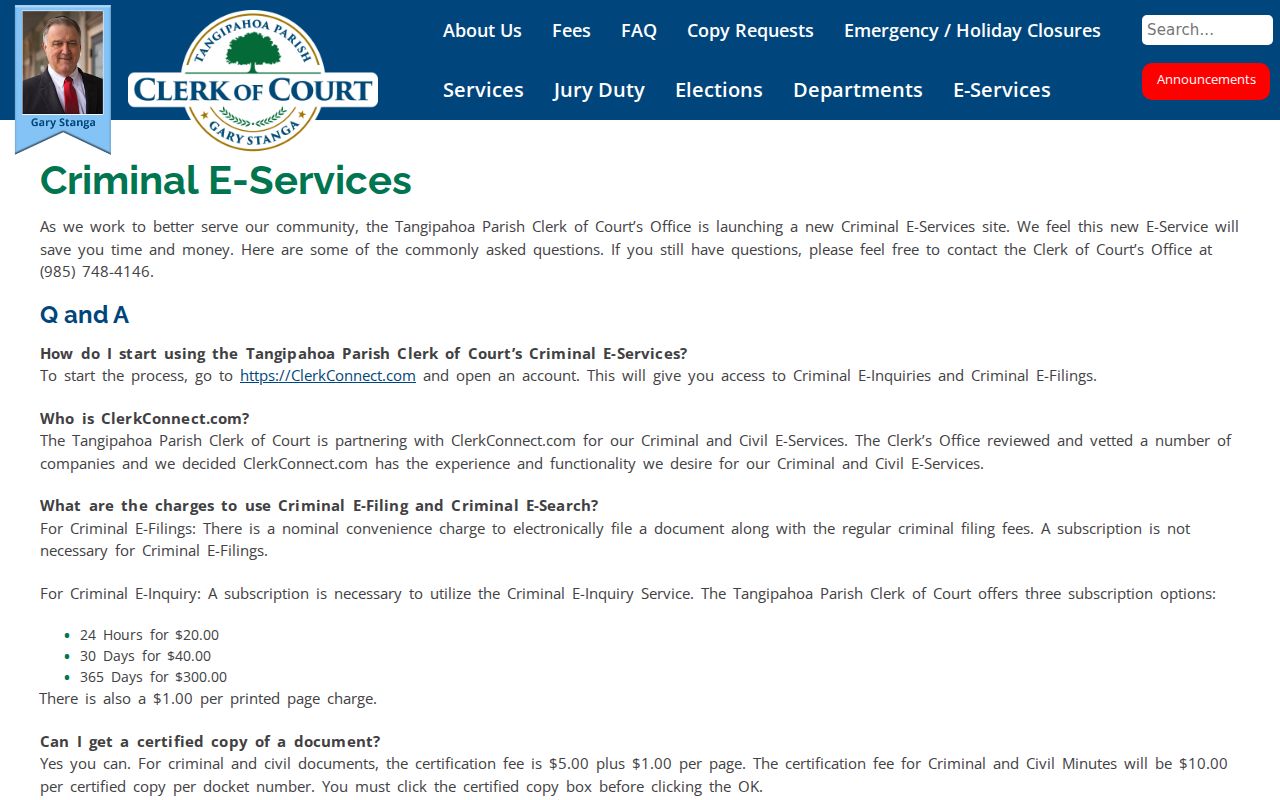
The Clerk's Criminal E-Services page names the online criminal service and its related record options.
The routing matters more than it first appears. A criminal docket search, a request for minutes, and a court-calendar check can each lead to different official materials in Tangipahoa Parish.
- Open the criminal eSearch information or ClerkConnect criminal inquiry.
- Use the identifying information available from the notice, filing, or prior court record.
- Read the court, division, date, and event before treating a result as the right matter.
- Confirm a live setting with the court or clerk, then request the needed copy or minute record.
Note: A portal result does not replace court confirmation of a current hearing date.
Tangipahoa Criminal Docket Access Choices
The paid route into the parish criminal record system is the ClerkConnect criminal inquiry. Subscriptions run $20 for 24 hours, $40 for 30 days, or $300 for one year. Printed pages add $1. The public login screen shows no case-level search fields until you sign in, so assume nothing about filters or result details you have not seen yourself.
A subscription may not fit. The Criminal Department offers a free public-use computer. Written requests cover what a screen cannot. A written criminal-history search costs $20 per name. A written disposition costs $10 per name, and a minutes extract is listed at $10. Each serves a different purpose, so pick the one that matches what you actually need.
Volume explains the setup. The 2024 Louisiana Supreme Court annual report shows 2,782 criminal filings and 11,954 traffic filings for Tangipahoa in the 21st JDC. Those are filing counts, not counts of people or outcomes. They show why criminal and traffic record channels stay separate.
The official ClerkConnect criminal inquiry page is the access point for the subscription service.
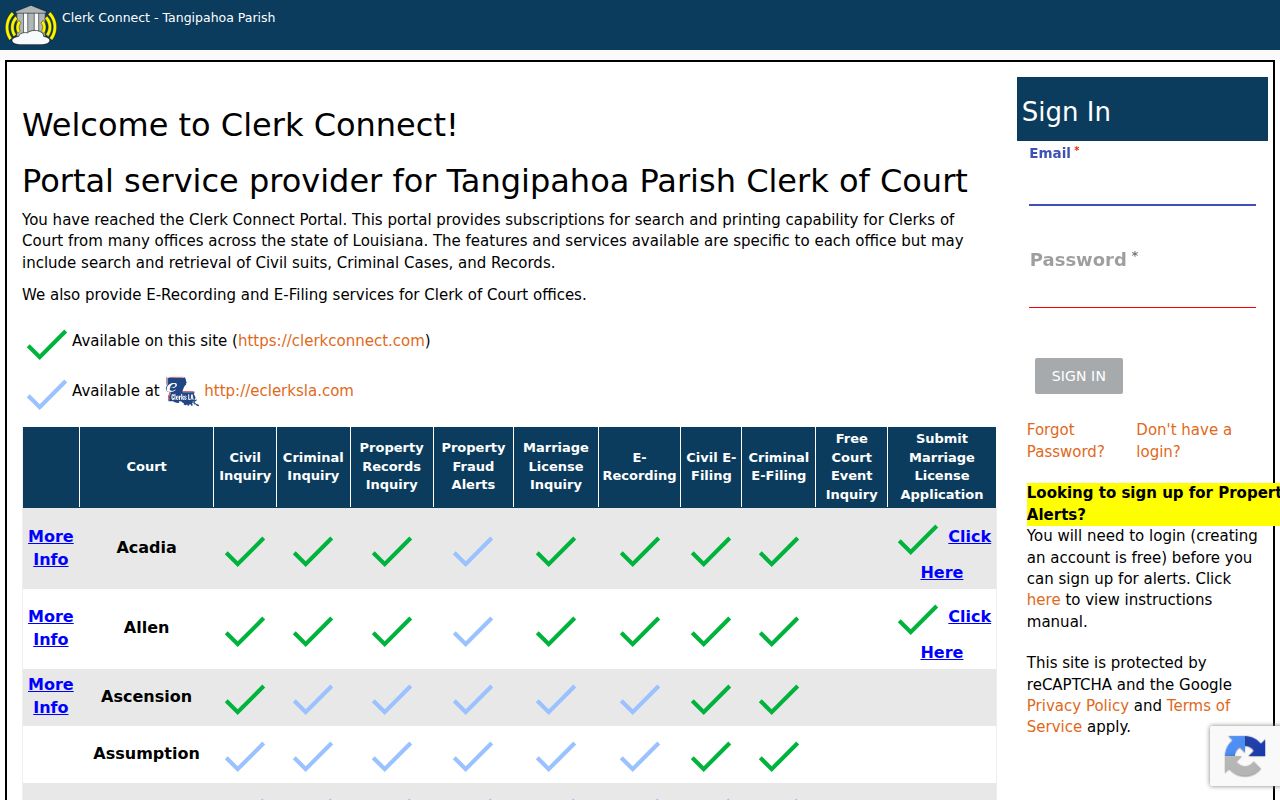
Pick the subscription period that matches the job, whether that is one quick lookup or ongoing record work. Just remember the portal may look different once you are logged in.
Inside a Tangipahoa Parish Criminal Docket
A Tangipahoa Parish criminal docket is an organized record of court action. It is not a verdict in shorthand. A public docket or calendar can show the court, parish, docket type, judge or division, scheduled date, case identifier, and the listed event. The Clerk's minutes are a separate record. They show what happened in a proceeding. A later order, judgment, or disposition may be its own filed record. Read the whole sequence before drawing conclusions.
ClerkConnect's exact case-level fields are visible only with an account. The record elements here come from the Clerk and court materials. They are not from any claimed online layout. Enter a number like [docket number from court paperwork] exactly as the court issued it.
| Court and division | Identifies the 21st JDC setting and the division shown on the docket or minutes. |
|---|---|
| Docket type and date | Shows the scheduled criminal, jury, priority, misdemeanor, or other court event and its date. |
| Case identifier | Connects the matter to the Clerk's file; its published local format was not documented. |
| Minute or setting | Records a court event such as an arraignment, motion, pre-trial, or continued setting. |
| Order or disposition | May require the related minute or filed document to establish the operative court action. |
Tangipahoa Criminal Docket Coverage Limits
Coverage runs deep but not unlimited. The Clerk describes criminal information back to 1901 and traffic information back to 1974. Criminal images start from January 2007. Backscanning continues, and the Clerk cautions that details before the 1980s may be incomplete. Those dates describe what exists. They are not a promise that every historic case has every document or a full online image.
An older result with no image may still need a Clerk request. Or it may need an in-person visit. When you ask for a paper file, minute extract, or copy, keep the exact docket number. Include the court, division, and date range. A missing online result says nothing about the person or the matter itself.
The Clerk's Criminal Record eSearch page publishes the historical-coverage and image information.
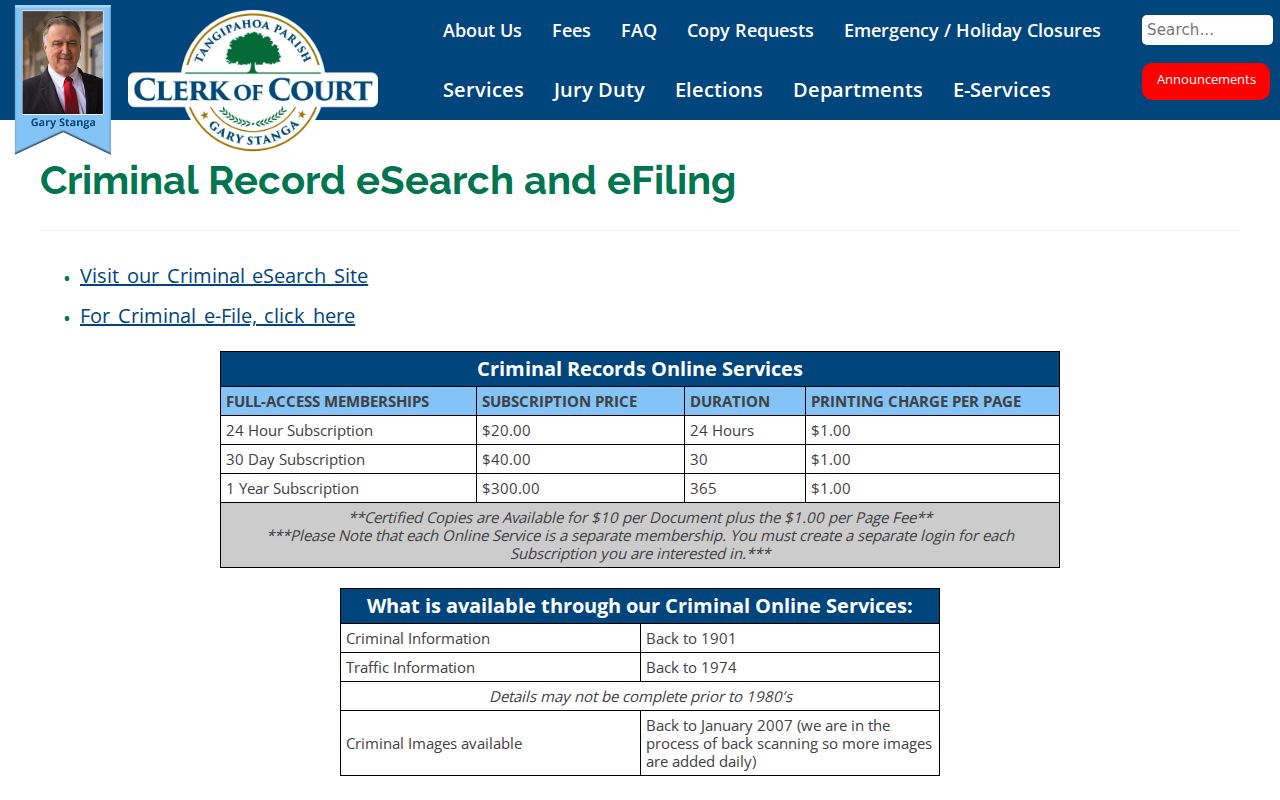
Check the coverage notice before treating an older online criminal docket as a complete file. It can identify a record while leaving images or minutes offline.
Note: Historic coverage can identify a record without delivering every related image or minute online.
How a Criminal Case Moves
In the 21st JDC, a docketed criminal case begins when the district attorney files formal charges. From there the case may move through arraignment, pre-trial settings, motion hearings, a plea, or trial. The path varies case by case. A calendar date alone is not the result of the hearing. A minutes entry documents action. It does not replace the signed order or judgment.
Docket flow: Filing → Arraignment → Pretrial → Plea or Trial → Disposition → Sentencing. A continuance or reset means a setting was postponed or moved. Read later entries and confirm with the court before acting on a listed date.
Tangipahoa Criminal Docket Terms
Court materials in Tangipahoa Parish use full local labels. Read them that way rather than guessing at generic shorthand. The labels you will see include criminal duty docket, criminal jury docket, priority list, misdemeanor docket, traffic court, arraignment, pre-trial, motion, and jury or bench trial week. The parish publishes no official code list for abbreviations like CONT or DISP.
A few definitions help. Minutes are the Clerk's recorded summary of what happened at a proceeding. A disposition is the recorded result or procedural conclusion. The reason and legal effect may take the related minute or order to understand. An arraignment covers the charge and the plea process. A continuance or reset simply moves a proceeding to a new date. It is not a final disposition.
- Criminal docket
- The court's organized list of criminal cases or scheduled matters.
- Minutes
- The Clerk's official summary of a proceeding and court action.
- Arraignment
- A criminal setting that addresses the charge and plea process.
- Disposition
- The recorded outcome or procedural conclusion of a matter.
Courts That Hold Criminal Dockets
The district attorney files felony and misdemeanor charges. For those cases, the Tangipahoa Parish Clerk of Court Criminal Department holds the 21st JDC docket. The office also processes pleadings, warrants, bonds, subpoenas, expungements, searches, minutes, evidence, and criminal appeals. Ten minute clerks cover the judges, the hearing officer, and the traffic division.
One parish office does not mean one search. Hammond City Court and the mayor's courts keep their own dockets for cases inside their jurisdiction. So begin with the right court. Use the one printed on your citation, notice, or filing. When the case sits in the 21st JDC, the Criminal Department is the right place. That is where the record lives. The Clerk Criminal Department page lists the records and filings that office handles.
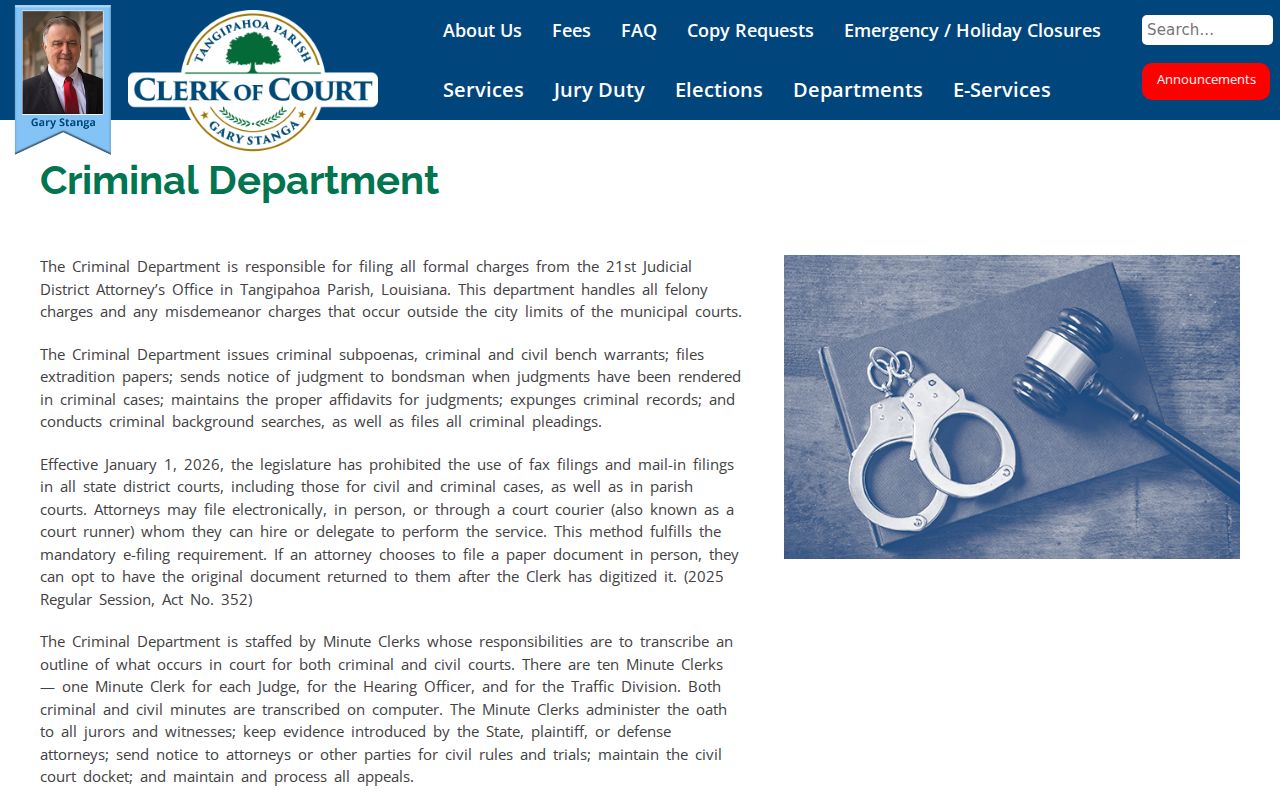
The department listing helps separate district-court criminal records from lower-court docket routes.
Tangipahoa Criminal Docket Calendars
The district attorney posts calendar lists that help with upcoming sessions in Tangipahoa Parish. You can find criminal duty, criminal jury, priority, and misdemeanor dockets there. Read them as schedules only. They are not the Clerk's full case history. And they do not replace a disposition, a minute entry, or a final order.
Dates on those lists can shift. The district attorney warns of that directly. So confirm any live setting with the court, your attorney, the Clerk, or the district attorney before you treat a PDF as the last word. That caution matters most after a reset. A later minute may not have reached an online view yet. The District Attorney Court Dockets page posts the criminal, priority, jury, and misdemeanor calendars.
Treat the posted lists as scheduling aids for now, since the official docket source carries its own warning that dates can change. Before you rely on any setting, check the date on the docket and look for a revision notice. A quick check beats a wasted trip.
Sealed Dockets and Public Access
Louisiana's public-records rules give you the right to inspect and copy open court records. But access has real limits. Juvenile proceedings stay confidential under Louisiana Children's Code article 412. The Clerk also restricts juvenile protective orders, adoptions, commitments, sealed files, and expunged records. So a missing or limited docket entry reflects an access rule. It is not a conclusion about the case.
Expungement works much the same way. Under Louisiana Code of Criminal Procedure article 973, an expunged record is confidential and not public. The exceptions are set by statute. Sealed or confidential copies require a signed judge's order, and a redacted public copy may be the only version available. If the Clerk denies a request, ask for the legal basis. Ask whether any non-exempt portion can still be produced.
Key Rules:
La. R.S. 44:31 gives adults the right to inspect and copy open public records, subject to lawful exceptions.
Children's Code art. 412 makes juvenile records and reports confidential except as the Code allows.
La. C.Cr.P. art. 973 treats expunged records as confidential and not public, subject to stated exceptions.
Tangipahoa Criminal Docket Requests
Need a formal copy of a Tangipahoa Parish criminal court record? Not just a screen result? Say which court, give the docket number, and name the record type. Then set the date range and format you want. There are several ways in. Options include eSearch online or a public-use computer at the office. You can also mail or bring a written request, call the listed phone line, or email the department. The Criminal Department handles criminal copy work at (985) 748-8015 and criminal@tangiclerk.org. Fees are posted plainly. An ordinary page costs $1, a conformed copy is $3, and a certified copy is $5. A conformed copy carries the Clerk's marking on it. A certified copy is authenticated by the Clerk.
Order the right product, though. A criminal-history search, a disposition, a minutes extract, and a transcript are four different things. Written history searches cost $20 per name, a written disposition runs $10 per name, and an extract of minutes is $10. The Clerk offers no public portal substitute for a certified disposition or a transcript. In fact, criminal transcripts require a signed judge's order before the Clerk will produce them.
| Criminal record request | Listed charge |
|---|---|
| Ordinary copy | $1 per page |
| Conformed copy | $3 |
| Certified copy | $5 |
| Written criminal history | $20 per name |
| Written disposition or minutes extract | $10 |
Charges in the district system do not file themselves. The 21st District Attorney Prosecution page lays out how that office formally files criminal charges across the district courts.
For any record request, the Clerk stays the route to the court file, the minutes, and copies.
Note: Confirm current fees and availability with the Criminal Department before you send a request.